Why Flat Roofs Are Their Own Discipline
A flat roof is really a low-slope roof, and the difference from a pitched roof is what water does on it. On a slope, water leaves in seconds. On a low-slope roof it moves slowly, lingers at drains, and stands wherever the structure has settled. So instead of overlapping pieces shedding water downhill, the roof needs a continuous waterproof membrane whose seams can hold water sitting on top of them.
In Los Angeles the membrane fights two opponents: the rare but concentrated rain, and the sun, which works on the surface every day in between. Every flat-roof decision — material, color, seams, coatings — is really a decision about those two opponents, and about how fast the roof gets water off itself.
TPO: The Reflective Single-Ply
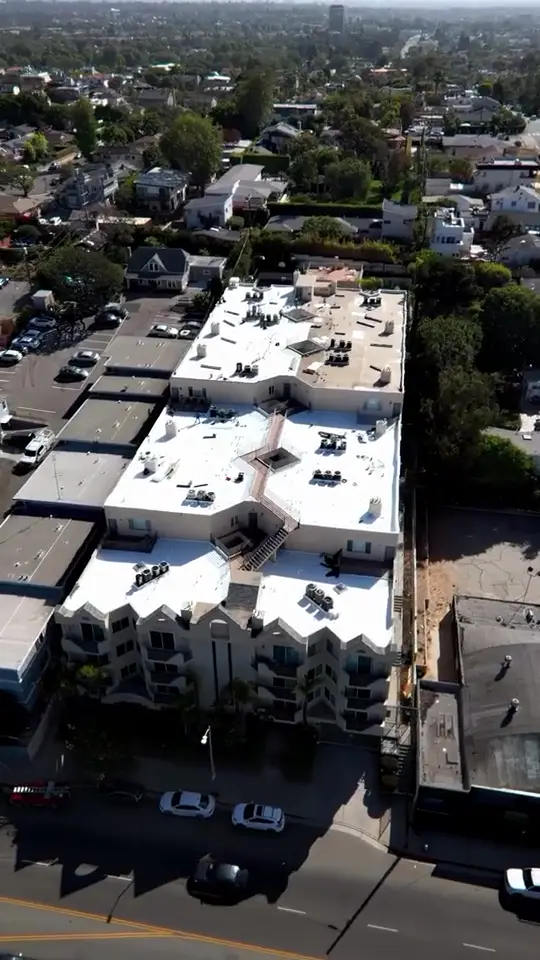
TPO is a single-ply thermoplastic sheet, rolled out in wide widths and heat-welded at the seams. The welds fuse the sheets into one continuous skin rather than gluing edge to edge. Its bright white surface reflects the sun instead of absorbing it, which is easier on the membrane and on whatever cooling equipment works beneath it.
That relative durability in constant sun is what earned TPO the commercial market, and its weakness is the flip side of its strength: the system is only as good as its welds. TPO rewards a crew that welds cleanly and probes its seams, and punishes one that does not — which makes the installer a bigger variable than the brand on the roll.
Torch Down: The Modified Bitumen Workhorse
Torch down is modified bitumen: asphalt blended with rubberizing polymers, made in rolls and fused to the roof with controlled flame so the layers bond into a thick, monolithic mat. It is the tank of flat-roof systems: heavy, forgiving, and tolerant of the foot traffic, equipment, and general abuse a working roof absorbs.
Its trade-offs are heat and application. A dark or smooth-surfaced torch roof runs hot in the sun unless it is granule-surfaced or coated, and torch application belongs in experienced hands for obvious reasons. Where a roof carries equipment, sees regular service visits, or takes mechanical wear, torch down's toughness is the argument for it.
Silicone and Acrylic Coatings: Restoring, Not Replacing
A coating is not a roof; it is a renewal of one. Silicone and acrylic systems are fluid-applied over an existing membrane that is still fundamentally sound, sealing the aged surface and buying it a new working life without a tear-off, without disposal, and without opening the building.
The two behave differently. Silicone tolerates standing water and shrugs off sun, which suits roofs with imperfect drainage. Acrylic is economical and performs well where the roof actually drains, but it wants to dry out between rains. Either way, a coating inherits everything beneath it, which is why the inspection underneath matters more than the product on top.
When Coating Over Beats Tear-Off
Coating wins when three things are true: the existing membrane is sound, the assembly beneath it is dry, and the failures are local and repairable. Those are verified, not assumed. Moisture testing and core samples establish whether the insulation under the membrane is wet, because a coating over a wet roof does not fix the roof; it seals the water in.
Tear-off wins when the checks fail: saturated insulation, widespread seam failure, a deck in question, or a roof already carrying its limit of layers. A contractor who coats everything is selling a product. The honest answer comes from the cores, and it belongs in writing either way.
Drainage Decides More Than the Material
Ponding — water still standing on the roof long after the rain has stopped — ages every system on this page. Standing water concentrates dirt and debris, magnifies sun exposure, probes every seam it covers, and adds weight the structure was not asked about. A well-drained roof in any of these systems will outlast a ponding roof in the best of them.
That is why the highest-value line on a flat-roof scope is often not the membrane at all: added drains or scuppers, crickets that steer water, tapered insulation that rebuilds slope the structure lost. Fix how the roof drains and every material choice gets easier. Skip it, and no material choice will save you.
| System | What it is | Where it wins | Trade-off | When it's the wrong call |
|---|---|---|---|---|
| TPO | A single-ply thermoplastic sheet, rolled out wide and heat-welded at the seams into one continuous skin. | Constant sun: the bright white surface reflects it instead of absorbing it. | The system is only as good as its welds, which makes the installer a bigger variable than the brand on the roll. | When the crew will not weld cleanly and probe its seams. |
| Torch down | Modified bitumen — asphalt blended with rubberizing polymers, fused with controlled flame into a thick, monolithic mat. | Roofs that carry equipment, take service visits, or absorb mechanical wear. | A dark or smooth-surfaced torch roof runs hot in the sun unless it is granule-surfaced or coated. | Where surface heat is the problem and nothing is protecting the surface. |
| Silicone or acrylic coating | Fluid-applied over an existing membrane that is still sound. A renewal of a roof, not a roof. | Sound, dry roofs with local, repairable failures (no tear-off, no disposal, no opening the building). Silicone also tolerates standing water. | A coating inherits everything beneath it, so the inspection underneath matters more than the product on top. | Saturated insulation, widespread seam failure, a deck in question, or a roof already carrying its limit of layers. |